What Breaks in HubSpot When Visitor Data Volume Spikes
Most visitor spikes expose hidden flaws in how HubSpot processes data at scale.
- Written by
- Renata SłowikStaff Writer
- Published
- October 10, 2026
- Reading time
- 11 min read
What this covers
When visitor data volume spikes in HubSpot, the platform does not simply get slower. Specific, identifiable parts of the system stop working the way they do at normal load, and the cause sits in how HubSpot is built. HubSpot's own incident report for July 22, 2026 shows a service that absorbed a latent defect overnight while traffic was light, and then, once the European business day began and load climbed, it ran out of available resources, producing severe performance degradation on CRM pages for under an hour. A separate incident, from March 27, 2025, shows the same underlying pattern on the email side: an internal component sent an unusual pattern of large atomic writes, which caused hotspotting on the Apache HBase cluster behind critical email operations, which in turn triggered a wave of retry attempts from other parts of the system. Both incidents share the same signature: capacity that looks fine at baseline vanishes once load concentrates, and retries piling on top of the original problem make recovery take longer than the spike itself. That signature, not a list of unrelated glitches, is what this piece sets out to trace through enrichment, attribution, and the integration layer, because the mechanism behind each failure is what a team actually needs to know in order to harden against it before the next spike arrives.
How enrichment stalls when inbound records lack required identifiers
HubSpot's enrichment does not fail just because too many records arrive at once. It fails because enrichment is gated by identifier quality in the first place, and volume just makes the gate visible. A contact has to carry a business email address before enrichment will touch it; personal domains such as Gmail or Yahoo are excluded. A company record needs a domain name before HubSpot will attempt to fill it in. At normal traffic levels, the share of contacts that fail these conditions is a manageable nuisance, a few records a rep can fix by hand. During a spike, driven by a viral post, a product-led growth event, or a high-traffic conference week, the mix of inbound records shifts hard toward personal emails and anonymous sessions, and the system was never designed to enrich those records, so the majority of what comes in during that window can end up structurally invisible to enrichment.
Even the records that do clear the gate come back only partly filled. HubSpot's native enrichment fills around fourteen contact properties and about thirty company properties, but it does not supply verified phone numbers, and the contact-level data that does come back includes name, company, and title without a working email address attached in every case. A sales rep can end up looking at a fully-named contact at a real company with no way to actually reach that person, because the one signal the deal most needs is the one piece the enrichment schema does not promise.
The write behavior makes the problem stickier than it looks. Automatic enrichment only fills blanks. It will not overwrite a value that a person or another system has already entered. A field that got populated incorrectly, by a bad form submission, a stale import, or a sync error, stays wrong indefinitely unless someone corrects it by hand or a mapping rule is specifically configured to allow overwriting. Combine that with the email and domain gates: the pattern becomes self-reinforcing, and records with no business email, no company domain, and an incorrect pre-existing field tend to cluster together. The worst data in the system is also the data least likely to ever get fixed automatically.
There is a second-order effect worth tracking closely. When enrichment runs at scale, with thousands of records processed in a single overnight batch, every property change on every one of those records can re-trigger workflows built to fire on exactly that kind of update. Those workflows were sized for ordinary volume, not for a batch enrichment run, and the resulting re-enrollment wave is a separate failure sitting on top of the enrichment gap itself.
A real-time visitor intelligence layer that resolves anonymous sessions to named individuals, filling in name, company, title, LinkedIn profile, and email at the moment someone visits rather than waiting for a form fill, closes the structural gap the native enrichment gate leaves open. Maverick Intelligence operates at exactly this layer, identifying visitors before HubSpot's enrichment preconditions have a chance to exclude them.
Why HubSpot's analytics miss anonymous and bot traffic
HubSpot's analytics only see what the tracking code sees, and the tracking code only runs when a browser renders JavaScript. Any request that skips that step, a direct server call, an API crawler, a headless fetch, leaves no session record and no contact touchpoint behind. The platform isn't missing this traffic by accident. It simply has no mechanism built to capture it.
AI crawlers now make up a fast-growing share of all web requests, and the signals that would identify them, user-agent strings like GPTBot or PerplexityBot (Google-Extended, by contrast, is a robots.txt directive rather than a crawler identity that shows up in a request), live in server-side logs and WAF events. HubSpot's analytics never look there. Some crawlers go further and disguise themselves: they rotate through residential IP addresses and spoof ordinary browser user-agent strings, so their requests show up in HubSpot reporting as plain, unidentified browser sessions. That inflates the apparent human visit count on a dashboard while adding nothing usable to contact or attribution data.
A spike makes this worse, not better. A campaign that pulls in a surge of human visitors also pulls in a surge of bot and crawler indexing activity, and HubSpot lacks a native way to separate the two signals or flag which "visitors" in a report are AI agents considering a purchase. A marketing team watching a spike in HubSpot has no reliable way to say, from the reports alone, what portion was real buyers, what portion was an AI agent doing research on a buyer's behalf, and what portion was noise. Every decision made downstream of that number, who gets enriched, what gets attributed, who gets followed up with, inherits that uncertainty.
Maverick Intelligence's crawler and AI agent detection works at the server layer where these signals actually exist, identifying traffic from ChatGPT, Claude, and thousands of other crawlers by what they request and who operates them, then surfacing that distinction inside the tools a go-to-market team already uses.
Attribution collapse into direct traffic during a spike
Even the human visits HubSpot does manage to track are vulnerable once a spike hits, because the conditions that cause attribution to fail are the same conditions a spike creates. A larger, more visible campaign draws a higher share of privacy-conscious visitors who decline cookies. It draws more people who research on a phone and come back to convert on a laptop. And the speed at which teams launch a campaign raises the odds that UTM parameters get applied inconsistently across different ad variants. None of these are new problems. A spike just runs all three at once and at a larger scale.
HubSpot's own analytics documentation names the specific mechanisms that push sessions into the Direct traffic bucket instead of the channel that actually earned them: internal IP addresses that were supposed to be filtered out but got added, changed, or dropped from the filter; email campaigns sent through a tool other than HubSpot without tracking parameters attached; and source tracking turned off for HubSpot's own emails. Each one is a configuration state, not a mystery, and each one routes real campaign traffic into a bucket that looks like it came from nowhere.
Link shorteners, redirect chains, and third-party tracking tools that handle UTM parameters inconsistently cause the same damage, and at low traffic the damage is small enough to ignore. At the scale a campaign spike produces, the same inconsistent handling turns into a large pool of mis-attributed sessions, because the volume running through the broken link multiplies the error.
The hardest version of this to fix is the one that happens before a contact record even exists. If no tool capable of resolving anonymous sessions to known identities was running during those earlier visits, organic visits, content downloads, and repeat sessions that occur before someone fills out a form cannot be attributed after the fact. Without that, the influence of the spike on pipeline gets permanently understated in the CRM, because the system only starts counting a person's journey from the moment it can name them.
The outcome is consistent across all of these causes: direct traffic climbs, the channels that actually drove the spike look weaker than they were, and the data a team uses to plan next quarter's spend rests on a classification that was wrong from the start.
API rate limits and the cascade into silent data loss during a spike
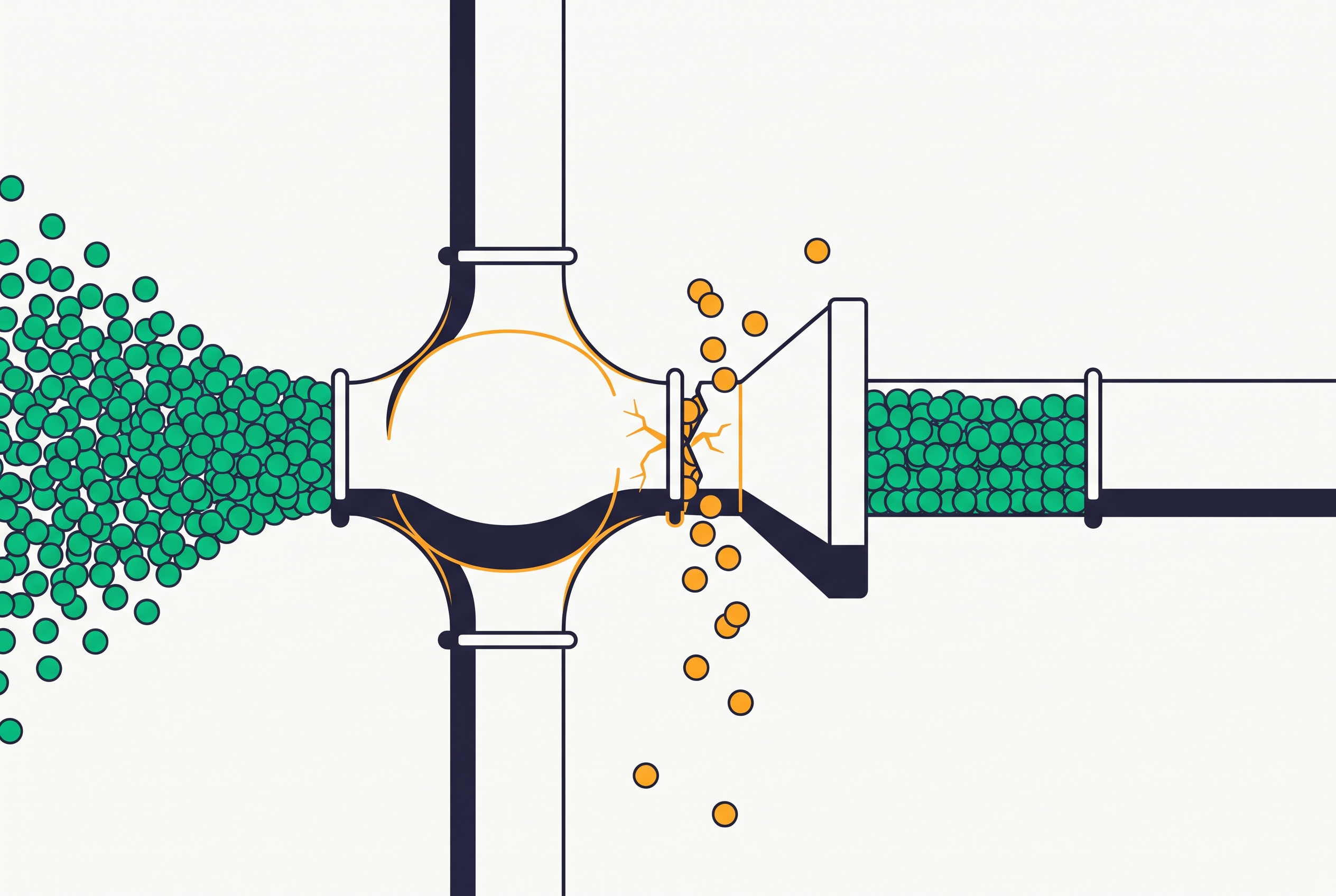
A spike in visitor data does not hit one system. It hits every connected system at once, because enrichment calls, Salesforce sync writes, Slack notification webhooks, and ad platform audience updates all draw from the same shared HubSpot portal API quota. When that shared ceiling gets reached, HubSpot sends back an explicit HTTP 429 error. The failure is visible in principle, but almost nothing downstream is built to watch for it.
The real danger is what happens next. Without jitter built into retry logic, every integration that receives a 429 response backs off for the same interval and retries at the same instant, producing a second spike that trips the rate limit again. That feedback loop can lock an integration out for minutes at a time, especially once multiple worker processes start coordinating their retries without realizing they're doing it. Webhooks start timing out. Sync jobs quietly drop records. Property history fills up with machine-generated edits, because the writes behind them retried several times over. This can stay invisible to a marketing-ops team in real time, since watching rate-limit logs directly requires continuous resourcing most teams do not have.
The July 22, 2026 incident shows how this spirals once it starts. HubSpot's own report describes overloaded instances that failed their automated health checks and got pulled from the pool, so capacity shrank further at the exact moment it was needed most, and a system that should have healed itself spiraled downward instead. The March 27, 2025 incident shows the same pattern from the infrastructure side: pausing the component that started the problem was not enough to end it, because database instability had already set off a wave of retries elsewhere in the email system, and recovery required clearing both the original backlog and the pile of retries sitting on top of it.
Fixing this at the architecture level means separating queues, batching reads, and designing integrations to be webhook-first rather than polling constantly against the same quota, and that is real engineering work, not a settings change a marketing-ops team can make in an afternoon. One practical lever does exist short of a full rebuild: integrations with Slack, Salesforce, and ad platforms that only trigger automated workflows for visitors who have already been identified as high-intent, rather than firing on every anonymous session, cut the number of writes competing for the same quota. Maverick Intelligence's integrations work this way: they route a pre-filtered, already-identified visitor set into the stack instead of pushing every anonymous hit through the same API ceiling.
Practitioners disagree on which failure matters most.
Teams that work inside HubSpot regularly do not agree on which of these failures deserves attention first, and the disagreement is not cosmetic. The enrichment email gate splits opinion sharply: one side treats it as a feature, a quality filter that keeps garbage records out of the enrichment pipeline, while the other side treats it as the central business problem, because a tool that requires an email address and never returns one cannot power outbound prospecting, and no configuration change closes that gap for an anonymous visitor or someone who only ever shows up with a Gmail address.
A second disagreement runs through attribution. The evidence points toward UTM inconsistency, not attribution model choice, as the primary driver of direct-traffic inflation, yet plenty of teams spend their time arguing over first-touch versus multi-touch models while leaving the actual redirect chains and link-shortener settings that are stripping parameters untouched.
The honest conclusion is that these failures do not sit in isolation from each other. A team that fixes enrichment without touching the API cascade will end up with cleaner contact records that still fail to sync reliably during the next spike. Which failure sits upstream of the others depends on a given team's own setup, and fixing the wrong one first just moves the bottleneck down the line.
What to harden before a spike arrives
Before a spike hits, a team can audit the expected inbound record mix for an upcoming campaign, estimate what share will carry personal emails or lack a company domain, and route that share to a server-side or third-party identification layer so HubSpot's native enrichment does not just skip them silently.
Server-side logs or a WAF layer should capture user-agent strings and IP-range signals that client-side analytics cannot see on their own, because that is the only reliable way to separate human buyers, AI agents, and background noise once a spike is underway.
Every active redirect chain and link-shortener path needs an audit for UTM stripping before a campaign goes live, HubSpot's email source tracking needs to be confirmed as active rather than assumed, and internal IP addresses need to stay excluded from the traffic count, because HubSpot's own analytics documentation names each of these as a confirmed cause of direct-traffic inflation.
On the API side, bulk lookups should move off the Search API onto standard list endpoints wherever that's possible, retry logic across every integration needs jitter added so retries don't land in the same millisecond, and 429-rate monitoring belongs in the logs now, before sync failures start showing up as gaps in CRM records.
These four fixes work in a specific order because the failures themselves cascade in a specific order. Hardening enrichment first reduces the volume of writes reaching the rate-limit ceiling, since fewer malformed records means fewer retries competing for the same quota. Hardening attribution second makes sure the records that do get created carry the correct source. Hardening the API layer third makes sure those correctly-sourced records actually survive the sync once load increases. Maverick Intelligence addresses the first two of these directly, resolving anonymous visitors to named individuals with company, title, LinkedIn profile, and email before HubSpot's enrichment gate can exclude them, and flagging AI agents and crawlers at the server layer where those signals actually live, so that what enters the CRM is identified, correctly attributed, and worth the API write budget it costs to keep there.