Clearbit Migration & CRM Sync Comparisons
HubSpot Breeze Intelligence vs Person-Level Visitor Sync
Breeze Intelligence resolves company visits, not individual buyers.

Breeze Intelligence is Clearbit. The product arrived inside HubSpot after a December 2023 acquisition, then relaunched under the Breeze name in September 2024 at that year's INBOUND conference. The rebrand has created genuine market confusion, because buyers evaluating "Breeze Intelligence" often don't realize they're assessing a version of Clearbit's enrichment and intent capabilities, now native to HubSpot's CRM.
The product bundles two distinct capabilities under one name. The first is data enrichment, which draws firmographic, demographic, and technographic fields from a pool HubSpot describes as 200 million company and buyer profiles. The second is Buyer Intent, which finds the companies behind anonymous website traffic by reverse-IP lookup. These two capabilities solve different problems. Conflating them is the first source of buyer confusion, and it's a confusion this piece works to clear away before any comparison can land.
The structural ceiling built into Breeze's Buyer Intent feature
Buyer Intent de-anonymizes traffic at the company level. It tells an organization which company visited, not which individual inside that company did the visiting. The mechanism behind this ceiling is straightforward: reverse-IP lookup maps a visitor's IP address to a corporate network range. That approach works well when traffic flows from office networks. It breaks down in three common scenarios: employees browsing from home networks, which resolve to consumer ISPs rather than employer ranges. VPN users, whose traffic appears to originate from provider addresses. International visitors, where IP-to-company databases simply have thinner coverage.
The consequences are practical and immediate. A sales rep who sees "Acme Corp visited your pricing page" still doesn't know which Acme employee to contact, and must run separate research to find a person worth calling. This isn't a weakness unique to HubSpot. It is the inherent limit of any tool that resolves identity at the network-address layer rather than the identity-graph layer. Over 60% of knowledge workers browse from home networks that resolve to ISPs rather than company names, which means the ceiling binds harder as remote and hybrid work have normalized.
How Breeze's credit system shapes what teams can actually track
Even within its company-level scope, Buyer Intent runs on a metered credit structure that constrains coverage at lower tiers. Tracking companies with Buyer Intent draws down HubSpot Credits, but data enrichment does not. That distinction matters. Most pricing writeups miss it, and it materially changes budget forecasts because a team buying Breeze for enrichment plus intent must plan for two different consumption patterns. Monitoring a custom signal in beta costs 50 credits per month. Monthly allotments vary by tier, scaling from a few hundred credits on Starter plans up to several thousand on Professional and Enterprise tiers on most Hubs. A Starter account with 500 monthly credits can track roughly 50 companies before the pool runs dry. Credits reset monthly, unused credits do not roll over, and when the monthly pool empties, credit-metered features pause until the next billing cycle. Additional capacity packs are available for a fixed monthly fee, while pay-as-you-go overage is billed in arrears in small credit increments.
The operational consequence is a prioritization problem. A team must decide in advance which companies to track, spending a finite monthly budget on a preselected list. Breeze Buyer Intent therefore suits ABM-style motions built around defined target accounts far better than open-ended discovery of unknown inbound visitors. The metering shapes what the tool can practically do, independent of what the underlying identification layer can resolve.
What person-level visitor identification actually resolves
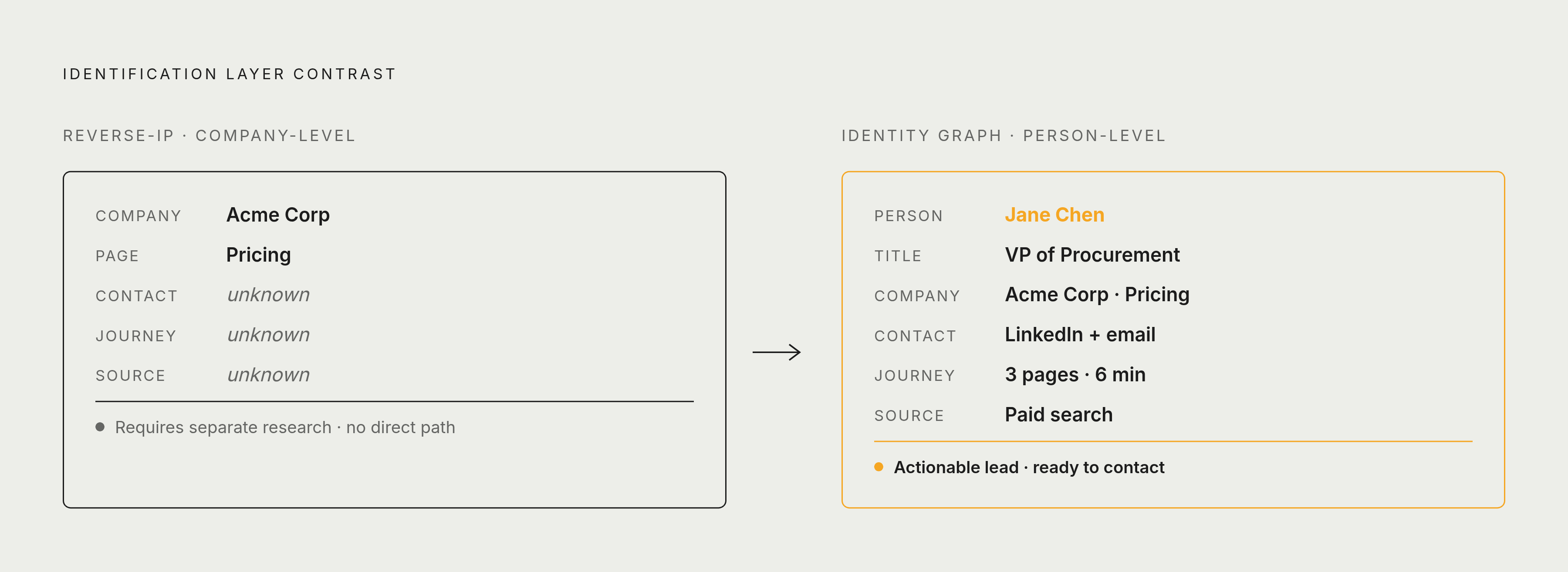
Person-level identification uses identity graphs and device-level tracking to resolve a specific individual behind a visit: name, job title, company, LinkedIn profile, and verified contact details. It's exactly what platforms like Maverick Intelligence deliver, not just a company name and reverse-IP signal, but a named individual whose record a sales rep can act on immediately. The difference in output is qualitative, not merely quantitative. "Acme Corp visited" sends a rep to a directory. "Jane Chen, VP of Procurement at Acme Corp, visited your pricing page, here is her LinkedIn and business email" is a lead. The mapping extends to how each layer communicates its results: a LinkedIn profile pinged into Slack is a notification. A person-level journey with email, phone, pages viewed, and ad source is an actionable lead.
Breeze Buyer Intent surfaces four signal types, including first-party website visits, third-party research-intent signals across external sites, company news events, and contact-level signals. These enrich the company-level record, but they do not resolve an individual. They make the account signal richer, never person-identified. The distinction is the entire point of the comparison.
Match rate realities at each layer and why vendor claims diverge from independent tests
The two layers achieve materially different resolution rates, and neither matches what vendors claim in marketing. Company-level resolution runs higher because it relies on network-range databases covering a large share of corporate IP space. Native HubSpot Breeze Intelligence can achieve strong match rates under ideal conditions, but performance degrades sharply when traffic arrives from residential IPs, mobile networks, VPNs, or shared ISP ranges, all of which have grown as remote and hybrid work have spread. Person-level resolution runs lower because most visitors don't carry an identifier that matches an identity graph: no persistent cookie, no prior form fill, no graph-linked device signal.
A realistic model of what a site actually sees across both layers shows most visits staying anonymous, a fraction resolving to a company only, and a smaller share resolving to a named individual. Both tools operate on a minority of total traffic, not the majority. One mechanical contaminant makes the numbers worse in every comparison: bot and crawler traffic, including AI agent crawlers whose volume has grown sharply in recent years, sits in the denominator of any match-rate calculation. That inflates raw visit counts without contributing real matches, so claimed rates look worse than the human-traffic-only rate.
The evaluation implication is straightforward. Test match rate on your own traffic during a trial, never read it from a vendor datasheet. Any vendor that doesn't separate AI agent and bot traffic from human sessions when reporting match rates is overstating what the tool actually identifies on real buyers. No industry-standard third-party audit framework governs how vendors measure or report these rates, so vendor figures aren't comparable without knowing the methodology behind them. That absence is the category's central credibility problem.
It tells an organization which company visited, not which individual inside that company did the visiting.
Where Maverick Intelligence fits in this stack
Maverick Intelligence operates at the person level, and what that delivers in practice is specific. Every identified visitor record carries name, title, company, LinkedIn profile, a business email with company-domain match preferred, a personal email, and a do-not-call-filtered phone number. The output is a contact a sales rep can act on, never a company-name ping. Beyond identification, Maverick attaches a full event journey to each person: page views, clicks, scroll depth, video plays, exit intent, form submissions, and copy events. Outreach gets timed and personalized to what that individual actually consumed, not just to the fact that their employer's IP appeared in a log.
Each record also carries classified seniority and job function, region, visit count, an ICP hot-lead flag, CRM status, and the traffic source and ad platform that brought the visitor to the site. Maverick detects and classifies AI agents and crawlers separately from human sessions, including ChatGPT, Claude, and thousands of other crawlers. Its match rates on human visitors therefore aren't diluted by bot traffic in the denominator, a distinction that matters when comparing identification claims across tools. For agencies, Maverick offers partner accounts where each client is a tracked domain with its own domain-scoped API key, a structure that mirrors how agency teams actually run across multiple clients.
How other person-level tools in the market compare
RB2B stands as the most prominent standalone person-level identification tool in this space, founded by Adam Robinson and launched publicly on March 1, 2024. It resolves individual visitor identity, including name, job title, LinkedIn profile, and company, and by default routes alerts to Slack. The Starter plan unlocks person-level identification, while the Pro plan adds business emails and CRM integrations. Routing to a CRM requires the Pro tier, and Zapier is also unavailable on lower tiers. The default output is a Slack notification with a profile card. That fits small teams monitoring inbound, though it serves less well for teams that need an identified person's full journey routed into a CRM workflow automatically.
The contrast with Maverick Intelligence comes down to what travels with the identification. Where RB2B's default is a profile card, a person-level record with a full event journey and source attribution carries more of what outbound and paid-media teams need. The gap between company-level and person-level identification becomes especially apparent when evaluating alternatives: Breeze's reverse-IP approach inherently caps out at the organization level, while person-level platforms that operate outside HubSpot, such as those integrated directly with Slack, Salesforce, and ad platforms, can deliver the individual identity that sales teams actually prioritize.
Compliance asymmetry between company-level and person-level identification
Geography sometimes decides the tool choice before any feature comparison begins. Person-level identification constitutes personal data processing under GDPR because it resolves individual names, emails, or device fingerprints. It requires a valid lawful basis, typically explicit consent, from EU and UK residents. Company-level identification, by contrast, maps IP addresses to business names and firmographic data without establishing individual identity. That can be permissible under GDPR's legitimate interest basis in Article 6(1)(f) when it doesn't involve personal data.
The practical consequence is sharp. Teams with meaningful EU or UK traffic cannot apply person-level tools to that traffic regardless of which vendor they choose. Person-level identification is permissible for US traffic under CCPA/CPRA, while international visitor traffic requires a company-level approach. The compliance asymmetry means the two layers are not simply ranked by capability. They map to different audience segments. A team with global traffic needs both, applied to the right segments. This is a structural design constraint, not a legal footnote.
Paid media attribution and the gap neither layer fills alone
Both identification layers feed ad attribution, but they produce different outputs. Company-level data enables audience suppression and account-level retargeting. Contact-level ad targeting, such as LinkedIn Matched Audiences by email, requires person-level identity signals that Breeze Intelligence does not produce. The gap is structural: one layer can tell you which accounts to exclude from a campaign, while the other can tell you which individuals to include.
Breeze Intelligence's data stays inside HubSpot. Teams using Salesforce as their system of record, or stacking multiple signal sources, must build outside Breeze or layer a separate attribution tool. Maverick Intelligence carries the traffic source and ad platform, Google, Meta, or LinkedIn, on each identified person record, and integrates directly with those ad platforms alongside HubSpot, Salesforce, and Attio. Paid-media spend can therefore be attributed to the actual companies and individuals it influenced. The attribution layer also exposes a match-rate issue: retargeting audiences built from unfiltered visitor data, with bot and crawler traffic included, waste spend on non-human sessions. Tools that separate AI agents and crawlers from human sessions before building audiences produce cleaner attribution, and that filtering feeds directly into how much of an ad budget reaches a real buyer.
Which capability a team actually needs and how to decide
The right question isn't "which tool is better." It's "what does my sales motion actually require from visitor identification." The answer differs by team size, traffic geography, CRM infrastructure, and outbound strategy.
Breeze Intelligence alone fits when a team is fully committed to HubSpot as the system of record and has no plans to use Salesforce or another CRM. It also fits when the primary goal is ABM-style account monitoring on a defined target list rather than open-ended discovery of unknown inbound visitors, or when a team needs native enrichment of existing HubSpot records without adding a separate vendor. Person-level identification, led by Maverick Intelligence, fits when sales reps need a contactable person rather than an account name. Because Breeze Buyer Intent's credit metering forces upfront prioritization of which companies to track, teams in that model must decide in advance which accounts matter most, a constraint that person-level visitor sync sidesteps by identifying individuals across all inbound traffic in real time, then letting Slack or CRM workflows surface the highest-value matches without requiring preselected account lists.
Person-level identification also fits when a team runs outbound-heavy motions and needs email, phone, LinkedIn, and visit context in a single record. It fits when the team uses multiple CRMs or tools and needs data to flow through APIs, webhooks, or MCP connectors rather than staying inside one platform. And it fits when bot and AI agent traffic is meaningful enough that clean match rates on human sessions matter for pipeline quality.
Many teams with global traffic and a HubSpot CRM will run both layers: Breeze for EU and international traffic at the company level, and Maverick for US traffic at the person level. Treat them as complementary, not competing. The evaluation process remains the same regardless of tool: run a trial on your own traffic, separate bot and crawler sessions before calculating match rates, and measure output by the share of identified visitors that become contacts a rep can actually work, not by the raw resolution percentage a vendor reports.